
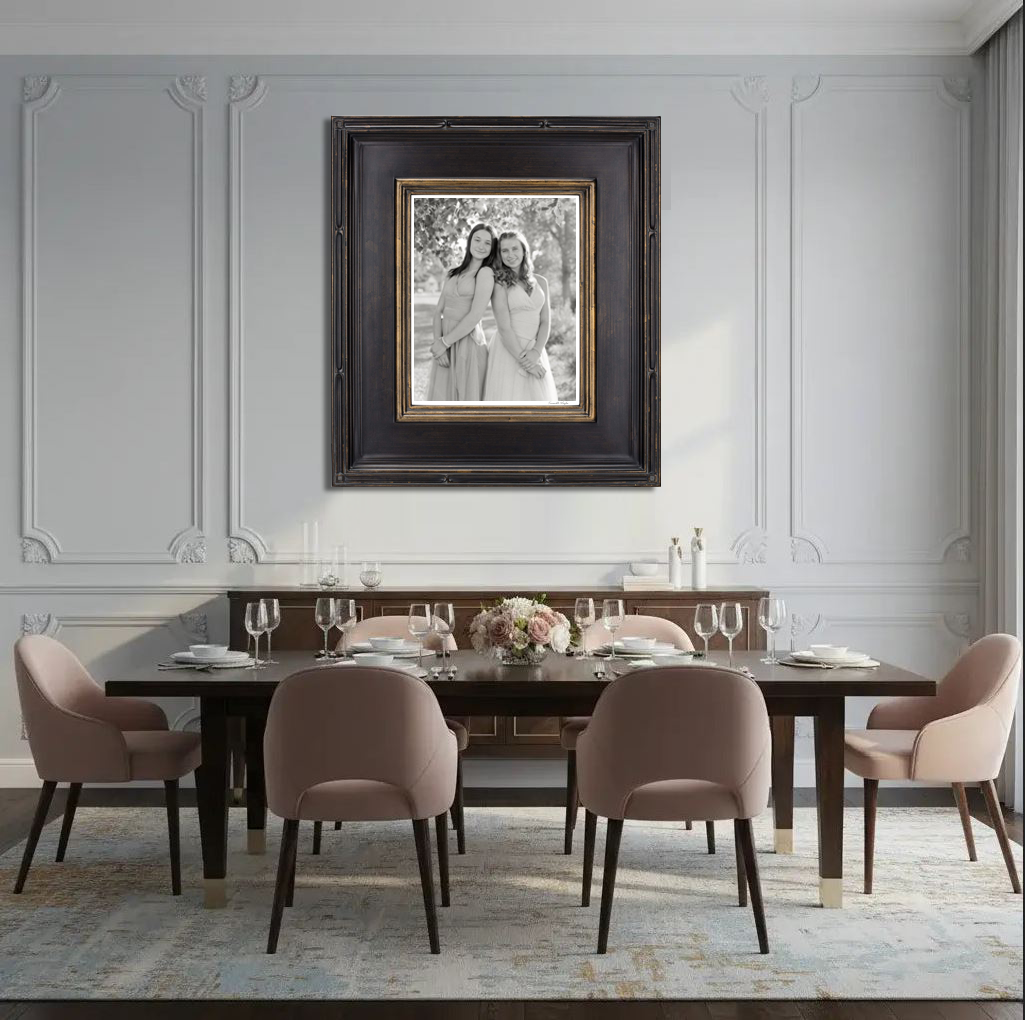
Why This Work Exists
Every family leaves behind possessions. Few leave behind a fine art portrait heirloom that allows future generations to encounter the faces, character, and presence of those who built the family.
For more than four decades I worked as a photojournalist, photographing presidents, artists, musicians, and ordinary people during extraordinary moments. That work taught me something beyond technique—it taught me how to recognize character.
Today I accept a limited number of private portrait commissions each year, continuing a photographic tradition carried through four generations. Each commission is conceived as a singular work of art created specifically for one family, one residence, and the generations who follow.
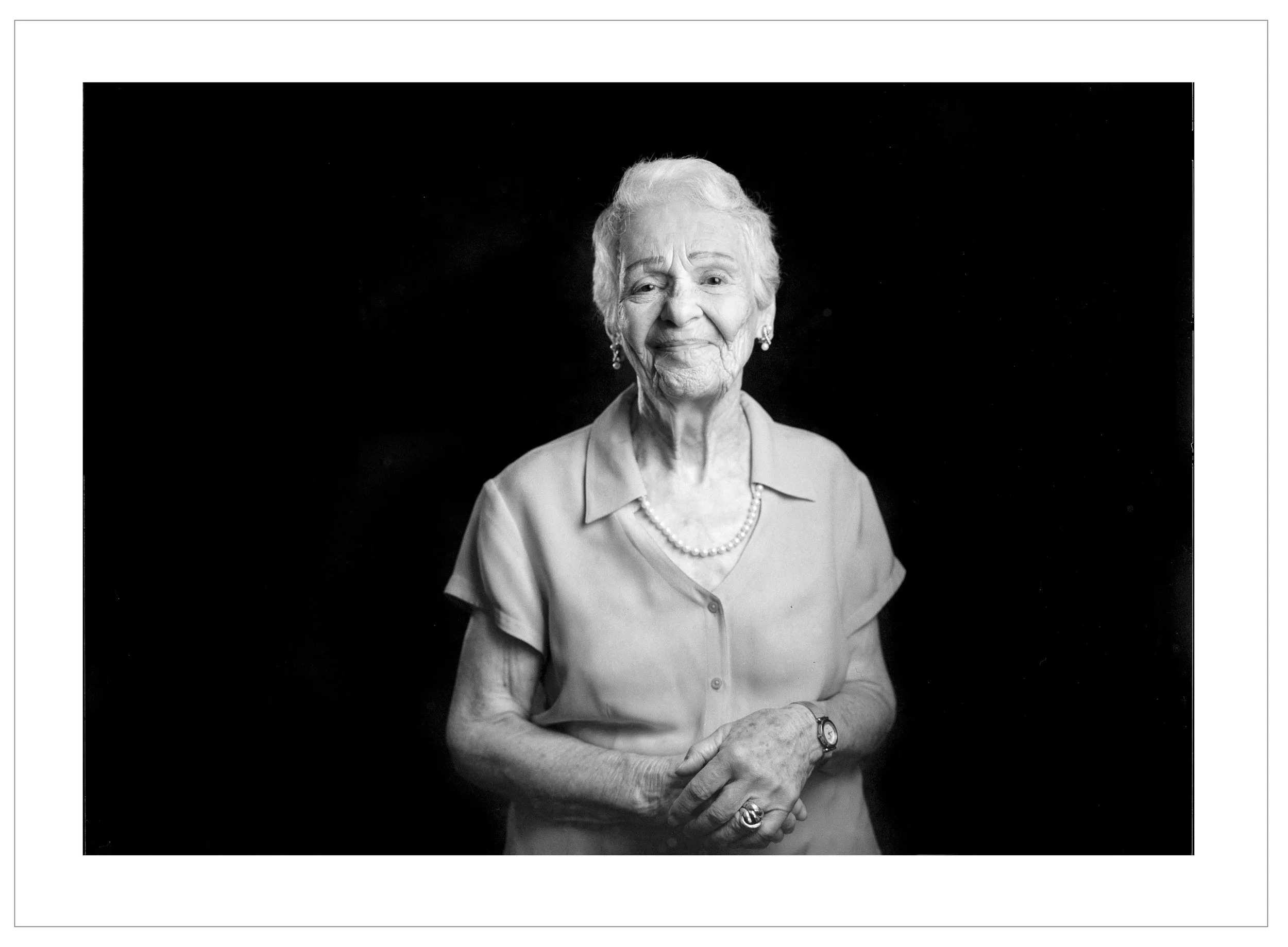
Large-format matriarch portrait made on gelatin silver black and white film and custom printed.
The Negative as Family Archive
Unlike conventional photographic commissions, the original negative itself becomes part of the family’s permanent archive. Every commission includes:
One original 8×10 large-format film negative, preserved as the family’s photographic master
One hand-printed silver gelatin exhibition portrait
Additional hand-printed silver gelatin editions may be commissioned before permanent archival custody of the original negative
Archival custody of the original negative is entrusted to the family
More Than a Century of Photographic Heritage
Andrzei Wajda — Poland
The roots of this work reach back to my great-grandfather, Andrzei Wajda, who was born in Szufnarowa, Poland in 1878. By 1900, he was obsessed with the craft of photography, making pictures with an intuitive eye for light and shadow. In 1902, his son, Antoni, was born.
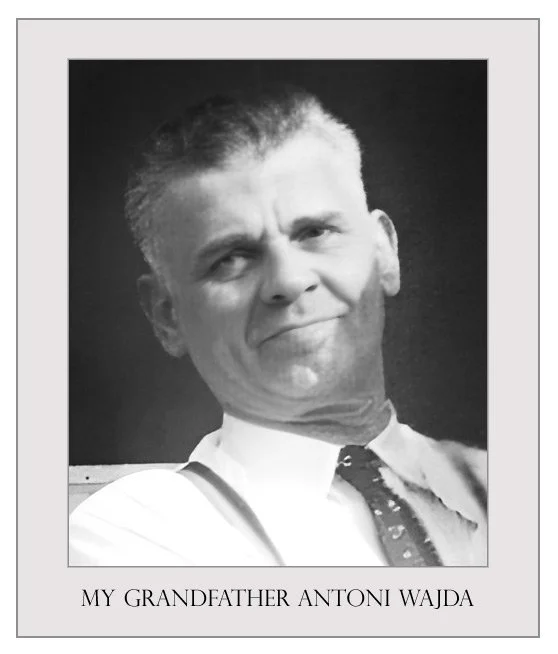
Antoni Wajda — Coming to America
In 1927, Antoni left for America, traveling by ship from Liverpool to New York. He settled in Philadelphia, bringing the family’s photographic tradition to the United States. While many photographers later adopted smaller 35mm cameras, in the 1930s, Antoni moved from wooden view cameras to a 4x5 press camera—the Speed Graphic. He documented working-class neighborhoods, industrial growth, the bustling street life across Philadelphia, and of course, his family life.
Henry Wajda — Philadelphia
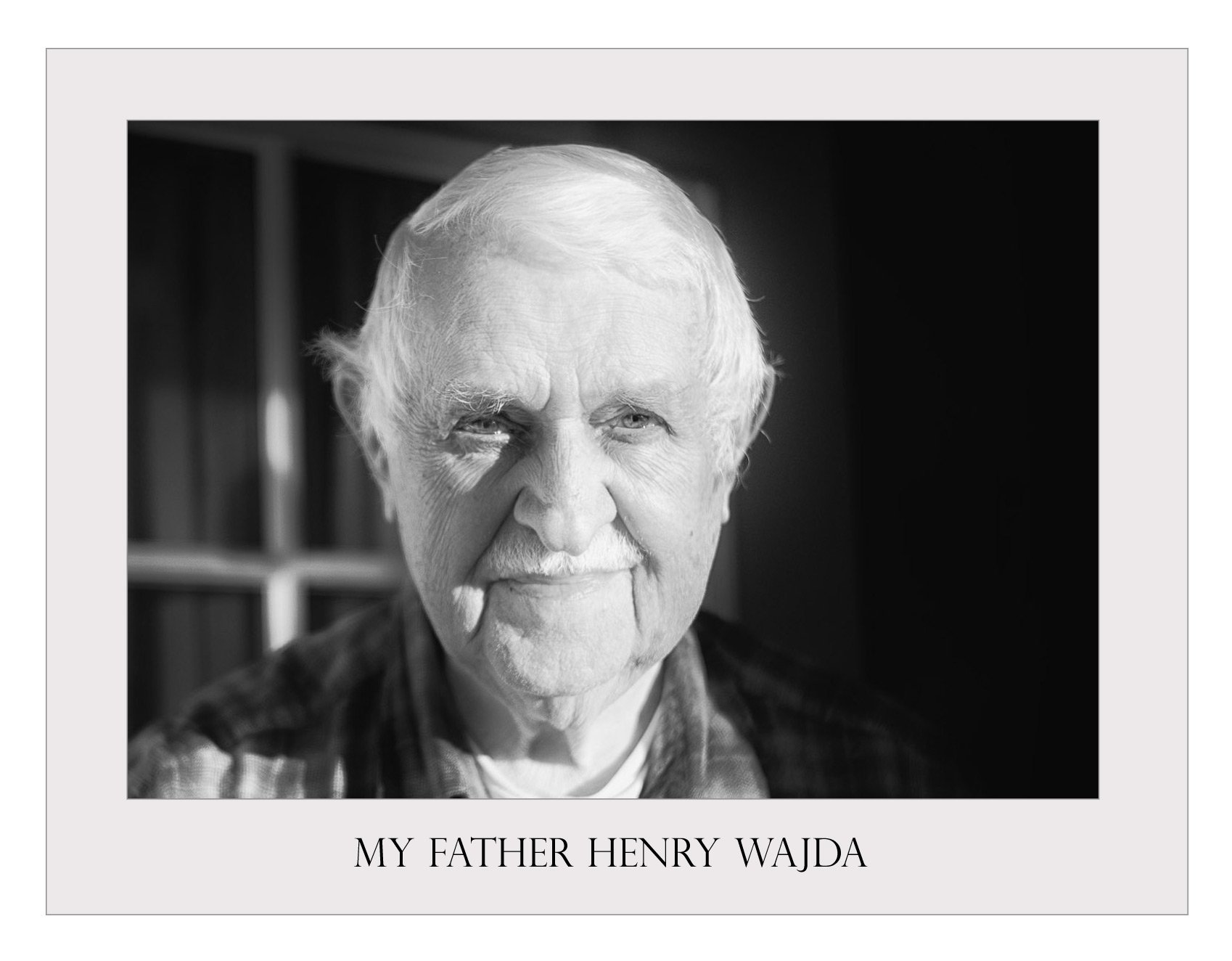
Born in Philadelphia in 1932, my father, Henry Wajda, continued the family tradition of photography. He used a Kodak 35mm Retina IIIc during his service in the U.S. Army. Afterward, he documented life in Philadelphia's Port Richmond neighborhood, the Italian Market where his parents shopped on weekends, and eventually his own family—including me. That camera eventually became mine.
Cinematic Echoes
Family histories often preserve stories alongside photographs. One family story recalls an encounter in postwar Kraków between my great-grandfather, Andrzei Wajda, and a young art student named Andrzej Wajda, who would later become one of Poland’s most celebrated film directors. Their meeting became part of our family history—a connection between two generations linked by a shared fascination with the art of photography.
Whether in photography or cinema, film has long been chosen by artists who value deliberation over speed. Many of today's most acclaimed filmmakers continue to choose it for their most important feature films and prestige television productions. I believe the portraits that define a family's history deserve that same level of care.
That philosophy has been carried through my family for generations. Today, that same stewardship is extended to families who wish to preserve their own lineage in a physical form. Just as cinema preserves stories on film, I preserve families on film, creating photographs intended to carry memory beyond a single lifetime.
The Origin of the Name
The studio operates under the name Kandrzej Archiva Fotografia.
Kandrzej is derived from my family's Polish heritage. This name represents our family roots, our history in Philadelphia, and the historic analog craft I still practice.
Archiva represents the physical permanence of large-format film. Just as the definitive films and television series of our time are committed to silver and emulsion, we choose this medium for work that matters. We archive tangible family history on sheets of film intended to be passed down for generations.
Fotografia uses the traditional Polish spelling for photography, firmly anchoring the brand to its Eastern European roots within the tradition of fine-art photography and historic photographic craft.
Now operating in the foothills of Boulder, Colorado, this photographic lineage is carried forward into every commission, creating a physical bridge between my ancestry and your family's lineage for generations to come.
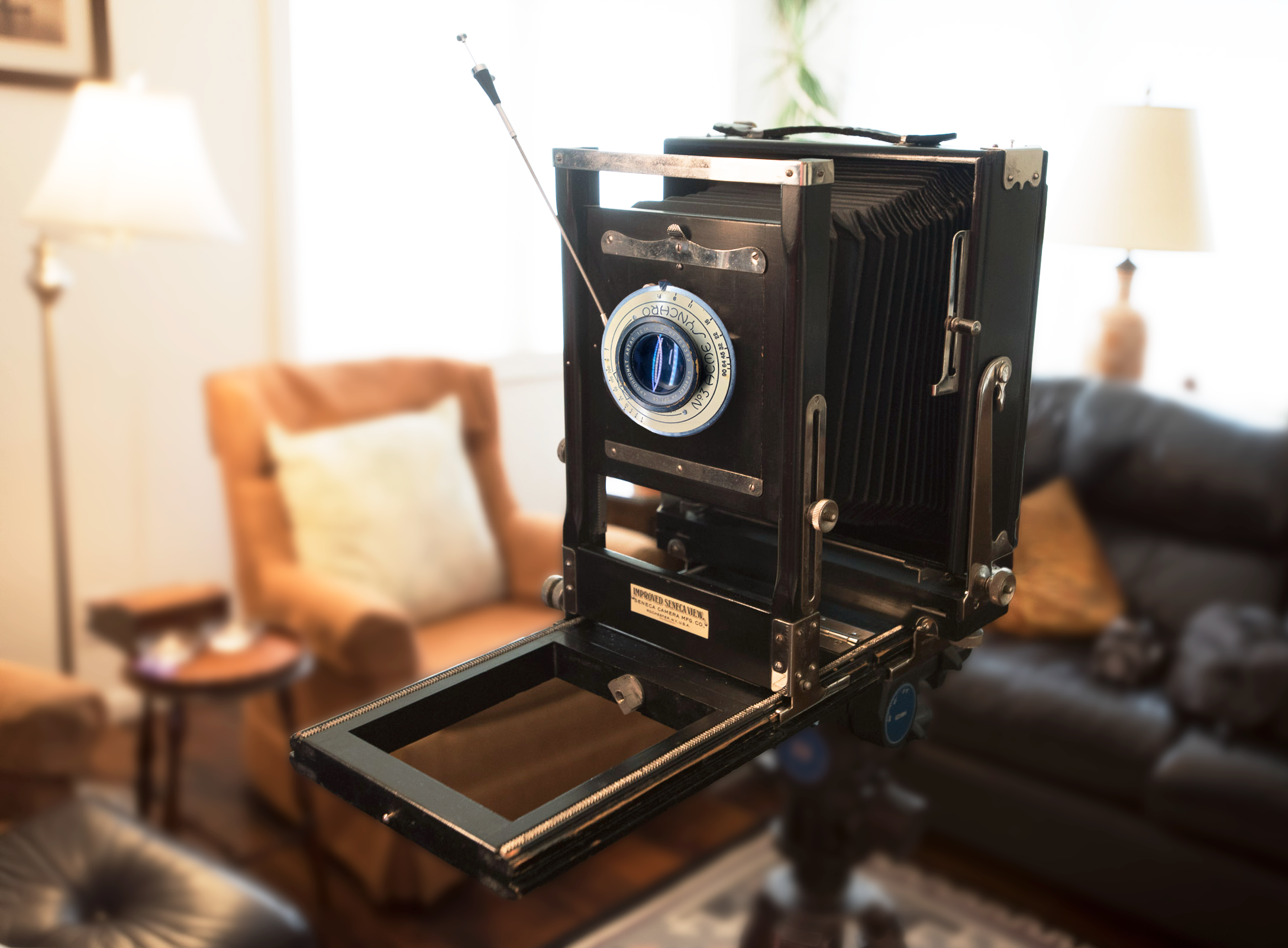
Seneca View Camera circa 1906 in use at a portrait commission.
The Artist Manifesto
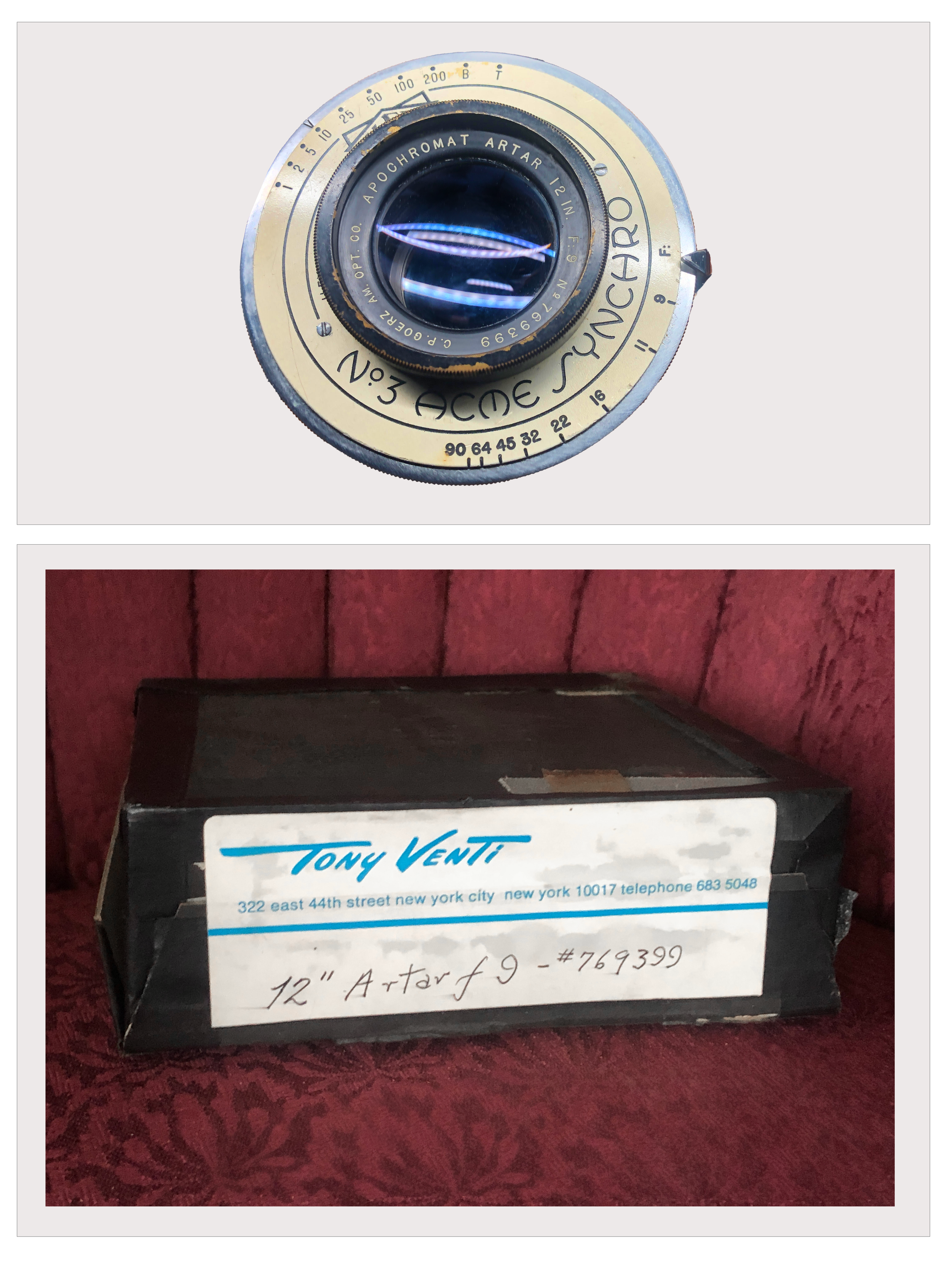
Goerz Apochromat Artar 12” F/9 portrait lens with No. 3 Acme Synchro Shutter. Acquired from the Tony Venti estate and accompanied by estate provenance attributing this lens to portrait work involving a young Marlon Brando.
I make portraits slowly.
Every commission begins with a single sheet of film.
The finished silver gelatin print is handmade in my darkroom.
The negative remains as a permanent record within your family archive.
Families spend generations preserving what they build. Portraiture deserves the same permanence.
Based in Colorado. Accepting commissions internationally.
— Kandrzej
Private Commission Availability
Because every negative is individually developed, every silver gelatin print is handmade, and every installation is personally overseen, the studio accepts approximately eight private commissions annually.
Each commission is individually designed for the family, residence, and generations it is intended to serve.
Private commissions begin at $17,500 and are considered through private consultation.
The Commission
Every commission is designed around a single finished portrait—created for the individual, preserved for the family, and conceived for the home in which it will live. The pace is deliberate, allowing each exposure to be considered with the care that large-format photography demands.
On large-format film, every exposure is a permanent record of a single, unrepeatable moment of light.
The photograph preserves the same light that touched you when it was made—held on film and waiting for those who come after us.
Over time, the physical photograph becomes more than an image. It becomes a connection—to a person, a moment, and a presence that once stood in the room. For future generations, it is a way of holding onto something that truly happened, in a form that still exists.
Each master sitting results in a single 8×10 film sheet contact-printed directly onto museum-grade 11×14 fiber paper. For prominent estate spaces demanding massive architectural scale—such as formal hearths or grand dining rooms—larger estate-scale editions are created through a carefully controlled archival reproduction process designed to preserve the character of the original negative.
Before the original negative is permanently entrusted to the family's archive, additional hand-printed silver gelatin prints may be commissioned. These companion prints are often created for children, private studies, or additional family residences before the negative is retired into archival custody as the family's photographic master.
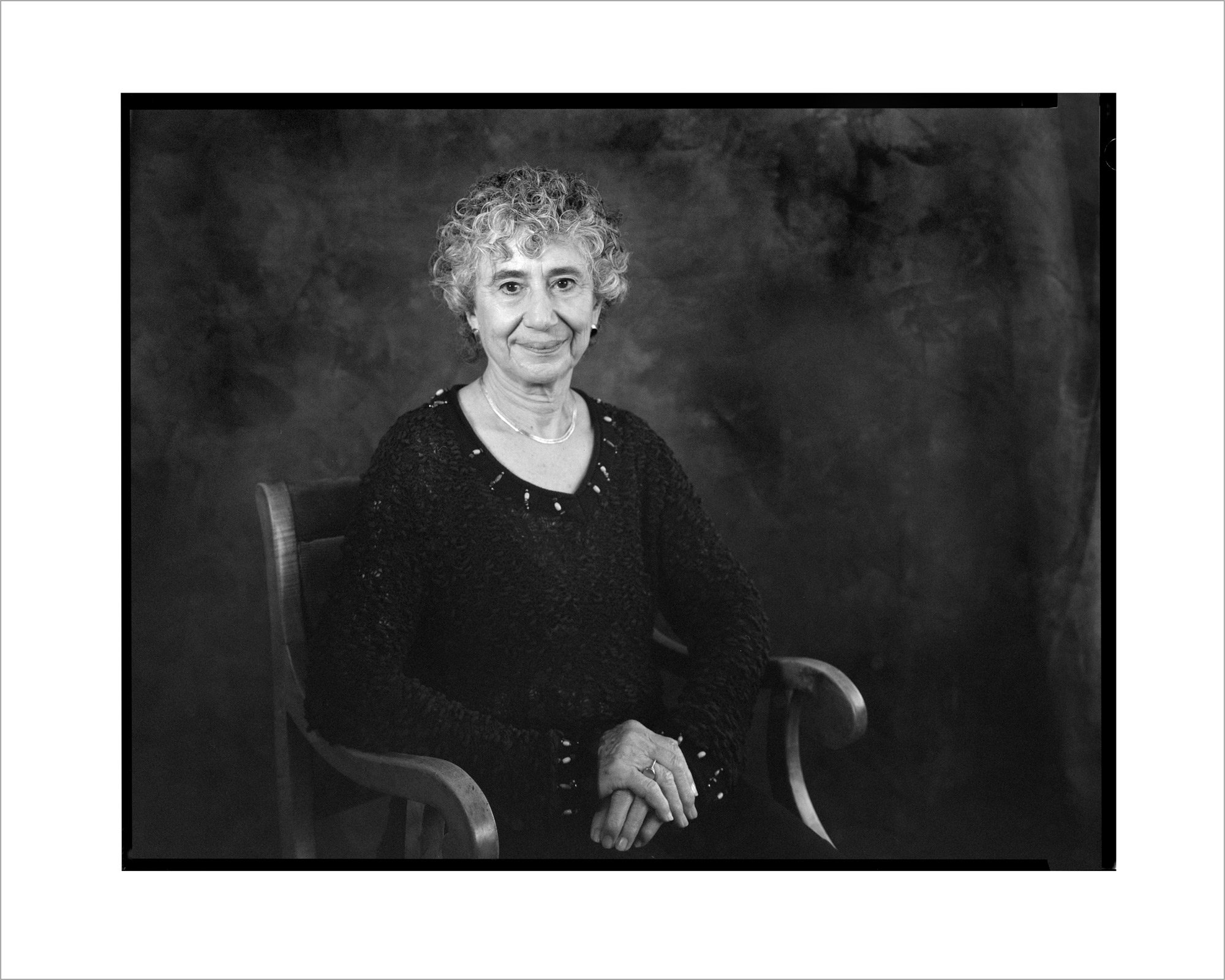
Large-format matriarch portrait made on black and white gelatin silver film and hand-printed in a darkroom.
The Fine Art Portrait Commission Process
I - The Consultation
A private introductory consultation to understand your family’s story, intended setting, and the character of the commission.
II - The Design
Every portrait is conceived for the place it will live. During the design consultation, we consider the architecture, natural light, scale, and character of your home before a single sheet of film is exposed.
III - The Sitting
Private commissions are created in the family home, estate, or chosen location worldwide. Large-format photography forces everything to slow down. The sitting is deliberately paced. The process allows time for observation, conversation, and the creation of a clean, honest portrait—a quiet study in character.
IV - The Darkroom
Hand development of the individual film sheets followed by archival silver gelatin printing. I personally mix the chemistry, process the film, and manipulate the tonal contrast under the enlarger to bring out the depth of the physical print.
V - Installation
The final silver print is mounted using museum-grade archival materials and presented in a custom-crafted frame. Where practical, I personally deliver and install the finished work.
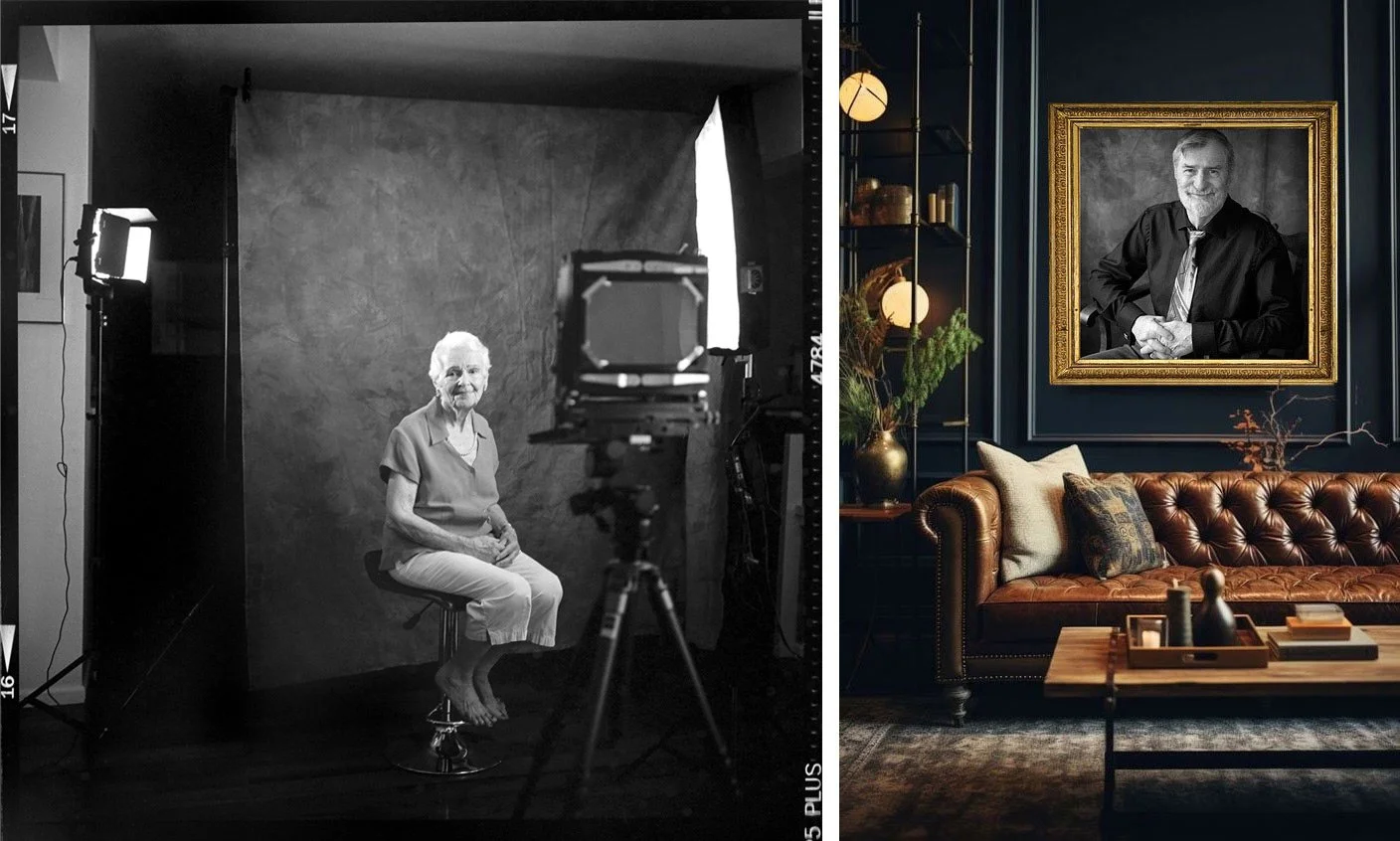
A matriarch large-format studio setup and a patriarch portrait commission custom-framed and displayed in a client’s home.
A Commitment to Client Privacy & Discretion
Privacy is a fundamental part of this work. To protect the security and privacy of my clients, a standard Non-Disclosure Agreement accompanies every commission. Client names, residences, and finished works are never shared publicly without explicit permission.
The Atelier Registry
The studio maintains a deliberately limited number of private commissions each year. Availability is discussed during a private consultation.
Protocol of Discretion
To understand how we protect our calendar and darkroom schedules, read our full Protocol of Discretion & Studio Policy.
Private Commission Notes
The Role of Silver Gelatin Film
Large-format silver gelatin film offers extraordinary tonal depth, detail, and archival permanence. The process itself requires patience and intention. Every portrait is created one sheet at a time, allowing it to become a considered study of character rather than a hurried portrait.
The Portrait as a Family Artifact
A commissioned portrait is not created as decoration for a room. It is created as an object of inheritance — a physical record of a person, preserved with the same consideration given to letters, manuscripts, and works of art.
The Commission Location
Commissions are hosted entirely at your location. Travel can be arranged for both national and international commissions following our initial design consultation.
The Creation Timeline
Commissions are typically planned several months in advance, allowing time for design, location considerations, and the deliberate preparation required by large-format photography.
Private Commission Inquiry
If you are considering a portrait commission for your family or estate, I invite you to begin a private conversation regarding availability, location, and the intended work.